Two permits, one mitigation requirement
Stream work in Tennessee usually needs two authorizations:
- An Aquatic Resource Alteration Permit (ARAP) from the Tennessee Department of Environment and Conservation (TDEC) under the state’s Water Quality Control Act. ARAPs cover alterations to any waters of the state, including small headwater streams.
- A Clean Water Act Section 404 permit from the U.S. Army Corps of Engineers (the Nashville District for most of the state) for discharges of dredged or fill material into waters of the United States, together with TDEC’s Section 401 water-quality certification.
Both agencies follow the same sequence: avoid impacts where you can, minimize what you cannot avoid, and compensate for what remains. Compensation for stream loss is called compensatory mitigation, and it is where credits come in.
How Tennessee measures stream loss and gain
Tennessee quantifies both the debit from an impact and the credit from a restoration project with the Tennessee Stream Quantification Tool (TN SQT). The tool scores a reach’s condition across functional categories, from hydrology and hydraulics through channel form, water quality and biology. Run it before and after an impact and you get a functional loss; run it before and after a restoration and you get functional lift. The units are expressed as SQT credits, and a permittee must acquire enough credits to offset the debit the agencies assign.
Because the tool weighs function rather than just length, a high-quality restoration of a badly degraded stream can generate more credit per foot than simple preservation, and impacts to better streams cost more.
Three ways to provide compensation
Federal mitigation policy sets a preference order, and Tennessee follows it:
- Mitigation bank credits. A bank is a restoration project that has already been built, approved and protected under an agreement with the agencies. Credits are released as the project meets performance standards and are tracked publicly in the Corps’ RIBITS database. Because the work is done before credits are sold, banks carry the least risk for the permittee and the environment, and they are the agencies’ first preference.
- In-lieu fee programs. You pay a program sponsor, who builds mitigation later.
- Permittee-responsible mitigation. You design, build, monitor and protect your own restoration project. Only practical for large projects with suitable land and a long timeline.
Service areas
A mitigation bank is approved to sell credits in a primary service area, usually a single 8-digit hydrologic unit (HUC-8), where the restoration’s benefits are felt most directly. Many banks are also approved for secondary service areas in neighboring watersheds, sometimes at an adjusted ratio. The agencies decide, impact by impact, whether a secondary-area credit is acceptable.
The Porterhouse Valley Mitigation Bank
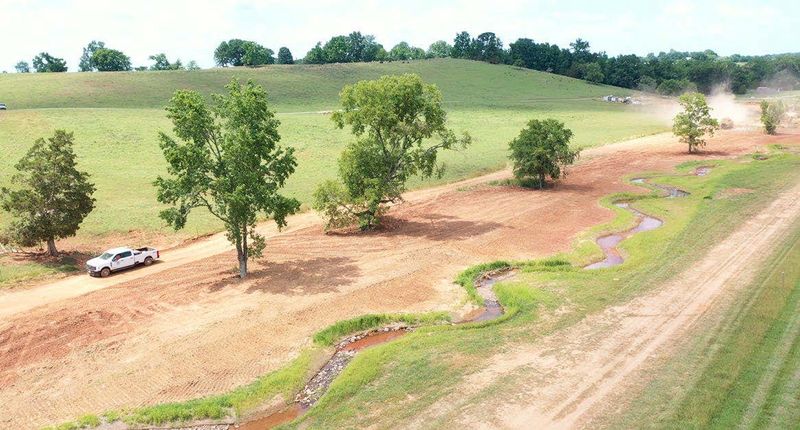
RestorEcology’s Tennessee credits come from the Porterhouse Valley Mitigation Bank, where two farm streams totaling 6,790 linear feet were rebuilt in their natural pattern, planted with native vegetation, fenced from livestock and protected by a 23-acre conservation easement. The bank is fully approved with 2,873 SQT credits available.
- Primary service area: Hiwassee River watershed, HUC 06020002 (Cleveland, Athens, Etowah and surrounding counties).
- Secondary service areas: Middle Tennessee–Chickamauga, HUC 06020001 (Chattanooga, Soddy-Daisy, Dayton) and Watts Bar Lake, HUC 06010201 (Kingston, Harriman, Lenoir City), subject to agency approval and applicable ratios.
Check a project address on our service-area map.
How to buy
Send us your project location, HUC-8 watershed and the number of credits required by your ARAP or 404 permit. We confirm availability by email, issue an invoice, and on payment provide a credit transfer letter suitable for TDEC and the Corps while updating the bank ledger. Request a quote or read more about stream mitigation credits.